Prescribed minimum benefits (PMBs)

BP Medical Aid Society approves funding for benefits based on treatment protocols for PMB conditions, following guidelines from healthcare authorities and best clinical practices. Prescribed minimum benefits (PMBs) are a set of limited conditions for which medical schemes are legally required to cover the costs related to the diagnosis, treatment and care, according to the Medical Schemes Act 131 of 1998.
Which conditions are covered
According to the Medical Schemes Act, medical schemes have to cover the costs related to the diagnosis, treatment and care of the following:
- Any emergency medical condition
An emergency medical condition means the sudden onset of a health condition that requires immediate medical treatment and/or an operation. If the treatment is not available, the emergency could result in weakened bodily functions, serious and lasting damage to organs, limbs or other body parts, or even death.
In an emergency, it is not always possible to diagnose the condition before admitting the patient for treatment. However, if your doctor suspects that you suffer from a condition that is covered by PMBs, your medical scheme has to approve treatment. Schemes may request that the diagnosis be confirmed with supporting evidence within a reasonable period of time.
- A limited set of 270 medical conditions called Diagnosis and Treatment Pairs (DTPs)
Diagnosis and Treatment Pairs (DTPs) are a limited set of ±270 medical conditions that qualify for PMB cover. A DTP links a specific diagnosis to a treatment and therefore broadly indicates how each of the approximately 270 PMB conditions should be treated. The treatment and care of PMB conditions should be based on healthcare that has proven to work best, taking affordability into consideration. Should there be a disagreement about the treatment of a specific case, the standards (also called practice and protocols) used in the public sector will be applied. Treatment and care for some of the conditions included in the DTPs may include chronic medication for HIV infection and menopausal management. In these cases, the public sector protocols will also apply to the chronic medication.
- The 25 chronic conditions that make up the Chronic Disease List (CDL)
-
The Chronic Disease List (CDL) specifies medication and treatment for the following 25 chronic conditions:
- Addison's disease
- Asthma
- Bipolar mood disorder
- Bronchiectasis
- Cardiac failure
- Cardiomyopathy disease
- Chronic obstructive pulmonary disease (COPD)
- Chronic renal disease
- Coronary artery disease
- Crohn's disease
- Diabetes insipidus
- Diabetes mellitus types I and II
- Dysrhythmias
- Epilepsy
- Glaucoma
- Haemophilia
- Hyperlipidaemia (high cholesterol)
- Hypertension (high blood pressure)
- Hypothyroidism
- Multiple sclerosis
- Parkinson's disease
- Rheumatoid arthritis
- Schizophrenia
- Systemic lupus erythematosus
- Ulcerative colitis
To manage risk and ensure appropriate standards of healthcare, so-called treatment algorithms were developed for the CDL conditions. The algorithms, which have been published in the Government Gazette, can be regarded as benchmarks, or minimum standards, for treatment. This means that the treatment your medical scheme must provide may not be inferior to the algorithms. If you have one of the 25 listed chronic conditions, your medical scheme not only has to cover medication, but also doctors' consultations and tests related to your condition. Your scheme may use protocols, formularies (lists of specified medication) and Designated Service Providers (DSPs) to manage this benefit.
-
PMB chronic conditions educational information
- picture_as_pdf Addison's disease
- picture_as_pdf Asthma
- picture_as_pdf Asthma devices
- picture_as_pdf Bipolar Mood Disorder
- picture_as_pdf Bronchiectasis
- picture_as_pdf Chronic kidney disease
- picture_as_pdf Chronic obstructive pulmonary disease (COPD)
- picture_as_pdf Coronary artery (heart) disease
- picture_as_pdf Crohn's disease
- picture_as_pdf Depression
- picture_as_pdf Diabetes insipidus
- picture_as_pdf Diabetes mellitus type 1
- picture_as_pdf Diabetes mellitus type 2
- picture_as_pdf Dysrhythmia
- picture_as_pdf Epilepsy
- picture_as_pdf Glaucoma
- picture_as_pdf Haemophilia
- picture_as_pdf Heart failure
- picture_as_pdf Hypercholesterolaemia (high cholesterol)
- picture_as_pdf Hypertension (high blood pressure)
- picture_as_pdf Hypothyroidism
- picture_as_pdf Multiple sclerosis
- picture_as_pdf Parkinson's disease
- picture_as_pdf Rheumatoid arthritis
- picture_as_pdf Schizophrenia
- picture_as_pdf Systemic lupus erythematosus (SLE)
- picture_as_pdf Ulcerative colitis
Application for out-of-hospital treatment of a prescribed minimum benefit (PMB) condition
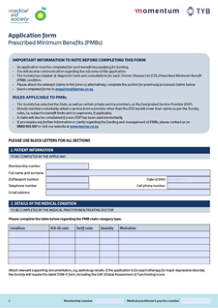
This form is to be completed by you, as the member, and your treating doctor. Please read each section carefully to ensure that you comply with all the requirements.
Understanding prescribed minimum benefits (PMBs)
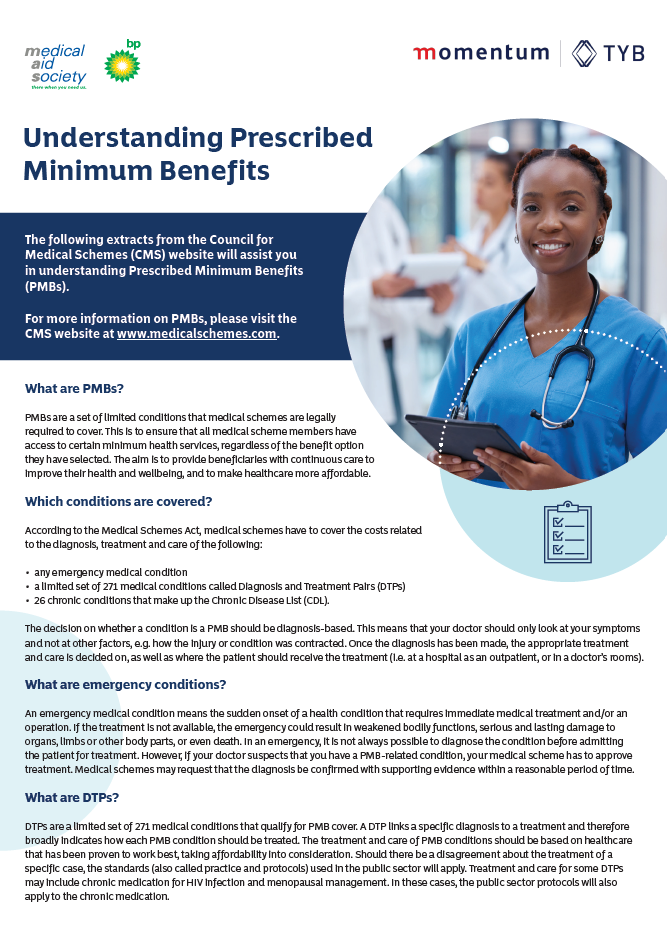
This information is from the Council for Medical Schemes (CMS) and will assist you in understanding prescribed minimum benefits (PMBs), which medical schemes are legally required to cover.